Thursday, 16 August 2018

Second interim report!

Day Three - Network Rail Volunteer days

The weather spoilt the party a little today and plans had to be changed and we had to find some indoor work.  However, before the rain came we managed to get a coat of primer onto the front cab sheet, having knocked the last of the rust off.
John shows Liliana what needs to be wire brushed
Having painted the front cab sheet they stand back and view their work
 
Whilst the paint dried and before the rain came attention moved to the rear cab sheet
 
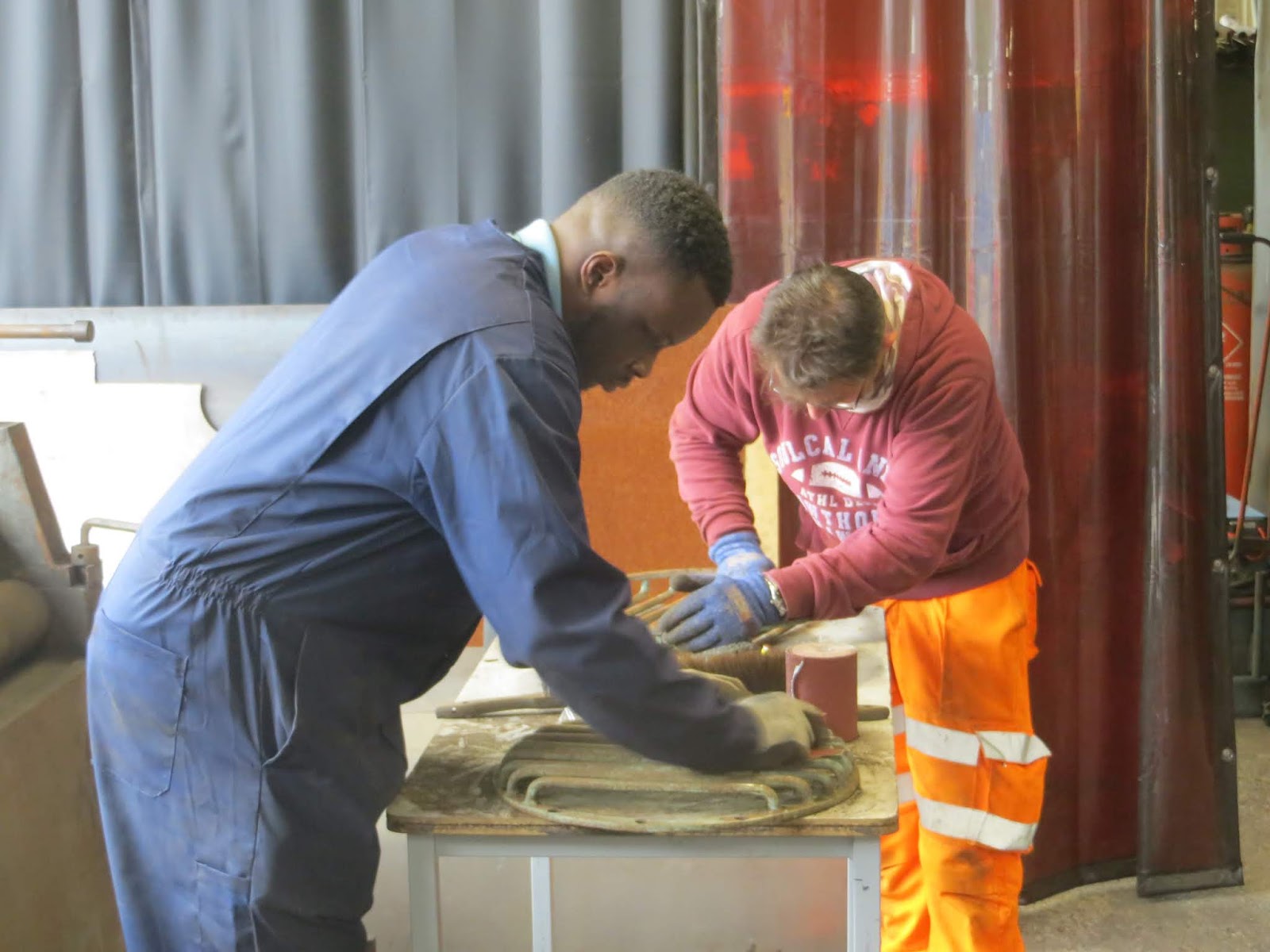
Following the break in the weather, John and Dabi are seen cleaning the rear window protectors
A close up of the cleaning process
One of the gutters from the side of the cab roof was given a basic clean by Clive
 

The other end after treatment

Liliana cleaning a smokebox handle during the rain disrupted day!
On day 4 we are confident we will be able to complete the painting of the outside of the cab.  There is a small amount of cleaning off to do first, but that should not take too long!  So it looks like mainly painting primer and possibly an undercoat on some of the cab too!
 
It is likely that we will need to complete the inside of the cab later, this is purely due to the weather on Day 3.  it is possible that we can do some of this work on Saturday during the monthly working day organised by Matt.
 
Of course, the labour was free to us via the Network Rail Volunteer day scheme, and the Project is grateful for this.  The materials used for the 4 days were purchased by the Fenchurch Fund as part of the support for Project 27 and this amounted to around £130.  This is a small amount in the scheme of things, but it still needs to be paid for. 
 
We value your support and interest in the restoration of the loco, and without your donations we could not continue the work we are doing. 

 
If you would like to help us with a donation, please go to our BT MyDonate page https://mydonate.bt.com/events/27
or use the QR code below.

 
If you would like to contact us please use the following address:
Thank you for your continued support and interest, it is much appreciated.

Wednesday, 15 August 2018

Network Rail Volunteer days Interim Report

Half way through the week!

We have made great progress over the last two days with most of the outside of the cab stripped back to bare metal, and a coat of primer on the roof!  We have added a few pictures as an interim report and a full report will follow after the weekend.

Day 1

Slow progress to start with!
Following a short tea break, things moved on!
 
Work was carried out on two levels
Jusat a few areas to be cleaned off wait for Day 2

 Day 2

More paint and rust removal
 
It became obvious that to get to the edges of the roof the gutters would need to be removed!
 
Dabi gets to grips with the paint and rust removal on the front cab sheet
 
More stripping!
 
So this is the ultimate "painting yourself into a corner"!
 
A view of the roof following Day 2
We value your support and interest in the restoration of the loco, and without your donations we could not continue the work we are doing. 
If you would like to help us with a donation, please go to our BT MyDonate page https://mydonate.bt.com/events/27
or use the QR code below.

If you would like to contact us please use the following address:
Thank you for your continued support and interest, it is much appreciated.

Monday, 13 August 2018

Preparitory work for the Network Rail Volunteer Days

Cab works

Many if not all of the small fittings, including the "sun roof" were taken off the cab structure this weekend in preparation for the Network Rail Volunteering days which are happening this week.  A team of up to 6 volunteers per day will be on site to carry out preservation work on the cab.  This is not a restoration but work to arrest the deterioration of the cab prior to a full restoration when it is required in a couple of years.  The reasoning behind this work is to maintain the plate work as patterns so that drawings can be checked and where required, modified to suit where required.

In the pictures below we see Sean Smeath beavering away on the removal of the sun roof runners by grinding off the rivets from below and then levering the runner away from the roof using a cold chisel.


Sean removing the sun roof runners
Hopefully the cab will look somewhat better by the time we have finished, we are hoping to get a coat of bonder primer and under coat on followed by a gloss coat.  Well, if Nick Knowles can rebuild a house in 9 days, I am sure we can make a P class cab look presentable!

Other works

Now that the holes have been cut and, where required, tapped Matt has taken the opportunity to start removing the mill scale from the frame sheets.  This is done using an angle grinder gently applied to the surface.
Matt removing the mill scale from the frame plates


Fundraising

We had a sales stand on Saturday just gone, this was at the Steaming through the Ages event.  Unfortunately we could not run a stand on Sunday due partly to the weather and partly due to a shortage of people to run it. We did have a good day, and together with the donations left at the railway it made it financially worthwhile too!  The following are a couple of pictures to give a flavour of the day.


Trying to sell Gerry Brown some chutney!
Guarding the signal box during the General Strike
Tea with Queen Victoria
Thank you for your continued support and interest, and please keep popping back for updates.


Tuesday, 7 August 2018

Mid Summer Update


A Major Step Forward


With the weather firmly on our side the restoration team, led by Matt, has made great progress towards achieving the goal of erecting the new frames by the end of the year!


With a few weekends and a couple of days holiday to spare Matt and Ben have all but completed the drilling of all the holes in the new frame plates! This is great news and a major step forward in the rebuilding of the loco.

Following on from the drilling, reaming and tapping of the holes in the frames, all of the horn slots must be machined square prior to the erection of the frames. Hopefully this will be carried out before the weather changes and working outside becomes untenable.


Also, at the July working day the team got together and took the plunge.  The disassembling of the remains of the old frames, turning it into a flat pack P tank! The pictures below show the process taking place.

We also welcomed Russ Hubner to the team who made himself most helpful drilling and shelling out broken stays in the front counterweight!  pictures of this process are also below.


The opportunity was also taken to have a good clear up of our little site and set-up a new area with better forklift access for assembling the new frames. This involved placing the wheels on their track panel where the old frames were to allow better access for working on the new frames.  You can get an impression of the changes from the aerial photo below.

Temporarily we have placed the cab in this area to help Clive Emsley and his team of Network Rail Employees who are giving their Charity works days assisting in the cleaning up and painting the cab and helping to preserve it from any further deterioration until the restoration of the cab is carried out.


Offsite the cylinder blocks, as well as all of the fitted bolts and studs, will soon be machined at Statfold Barn with an expected completion date set for the end of October. So hopefully by the "Giants of Steam" event we should have the new block back on site and ready to fit!


We are progressing well but we can only keep up the good work with regular donations from all you kind folk so if you feel you'd like to help us, be it a small or large donation, then please visit our online donate page below and help us see 27 run once again!


A birds-eye view of the July Working day with Russ busy shelling out and removing old stays in the front counterweight (Bottom left) and Ben and Sean removing the final few rivets in the old frames (top right) before dismantling. The new frames can be seen (now drilling has been completed) outside the villa.


The leading wheel set temporarily placed on the tramway outside Atlantic House, with Beachy Head's
boiler in the background
Matt gas cutting some of the final rivets holding the old frames together!
A close up of the operation to remove the final rivets
The re-build team busy working away at disassembling the old frames
Sean partakes of a quick cup of tea before the final push to remove the
last pieces of useful items from the frames
Matt making sure the lift will go correctly prior to lifting out the motion plate
The motion plate is removed without too much effort


Russ hard at work shelling out old broken studs from the front counterweight

Shelling out I hear you ask! This is the process of removing a snapped stud in a threaded hole.  It involves grinding the remains of the old stud flush with surface then drilling out the centre of the stud. The process is completed using a shelling tool to collapse the remains of the stud into the centre hole. This (hopefully) saves the threaded hole for future use following a clean up of the threads. 

The disassembly process begins with the removal of the frames from
the frame stands and placing on the ground

The frame stands are moved away and the frames are ready to be put down
And rest!
the frames are placed on the ground ready for the final stretcher and the temporary stays to be removed

 
With the last stretcher removed the chains are rejigged for the final phase, the splitting of the frames by removing the temporary stays


Finally the frames are dismantled the last piece being moved out of the way.

A close up of the marking out and scribing ready for the horn openings to be machined

Plenty of marking out on the frame plates ready for the machining of the horn openings
A close up showing the holes now drilled and some marked up for threads to be tapped
The original 1910 frames flat packed in the yard at Sheffield Park

The site now rearranged and tidied up.  The cab has been placed in the area ready for preservation work to be carried out to arrest  the deterioration of it.  This work is programmed to be carried out by a group of Network Rail staff during their charity engagement days.  The team will be led by Clive Emsley during the week following this weekends
"Steaming Through the Ages" event, and before the following weekends working day.  Hopefully it will look good following the process!

The rejigged are showing the "flat packed" frames, the wheels and other bits and pieces.
Our thanks go to Matt Holloway who not only is leading the project, had time to supply these fantastic pictures for the BlogSpot.

Sales and Information Stands


We are attending a few more events this year (so you have not missed your opportunity to buy one of our new tee shirts!)  These start with this weekends "Steaming Through The Ages"  We will be located at Sheffield Park on Platform 1 by our tanks (hopefully).

Please come along and say hello, there may be an opportunity for a couple of tours to see the frames and working site though this is subject to confirmation.

Other events this year include:
  • Burgess Hill Model Railway Exhibition 1st of September
  • Shareholders Weekend - Sheffield Park - 8th & 9th September (to be confirmed)
  • Worthing Model Railway Exhibition 22nd & 23rd September
  • Giants of Steam - Sheffield Park - 13th and 14th October
  • West Sussex N gauge Group Exhibition 3rd & 4th November
We look forward to seeing and talking to you at any of these events.

Please remember that the work can only continue with the donations, support and interest that is forthcoming from all of our supporters. 

 
If you would like to help us to continue this work with a donation, please go to our BT MyDonate page
 
 
 or use the QR code below.

Thank you for your continued interest and support. 

Monday, 2 July 2018

I found something out at the weekend!

Whilst discussing the machining of the holes on the frames at the weekend with Matt, I learned something about the way the holes are being machined.  I understood that the holes were being machined with cutters and not drills in the normal sense, but hadn't quite appreciated the subtleties of the process.
The  hole is, as I have described before, centre punched which created a positive location for the tool.  This is best shown in the picture below.
The annular cutter used for machining the holes
 The point seen on the tool is on a moveable spring loaded centre, this locates in the centre punched mark and ensures a true location for the hole (so the triple checking of the hole positions pays off!). As the cutter produces the hole, a pellet is formed which is connected to the frame plate until the cutter breaks through.
The Annular cutter with some of the pellets produced
In the picture the centre punch marks can be seen on the pellets.  This maintains position as the process is carried out.
A closer view of the pellets.
The use of this type of cutter ensures the quality and verticality of the hole.  It is not unknown for a "conventional" twist drill to wander off centre or produce an oval hole, both of which would prove disastrous to the quality of the frames. When the holes have been machined, and we are ready to start the erection of the frames, the holes will be reamed to final size and the fitted bolts or rivets will be inserted.


A small group of volunteers will shortly be spending a week cleaning and applying protective paint to the cab structure, currently stored on the top of one of the containers at Sheffield Park.  This is to arrest any further deterioration and will help in the restoration at a later date.
The cab structure shortly to be worked on.
 
Another view of the cab showing missing rivets in the rear corner joint.
 
The front quarter of the cab.
The work to be carried out on the cab will be purely protective but will allow us to make important decisions when it comes to the final restoration of it.  As the work is done notes and pictures will be taken to assist matt and the team later.


Please remember that the work can only continue with the donations, support and interest that is forthcoming from all of our supporters. 

 
If you would like to help us to continue this work with a donation, please go to our BT MyDonate page
 
 
 or use the QR code below.

Thank you for your continued interest and support.